
Understand the Clutch – Lose Your Fear of Stalling
Many new drivers worry about stalling when they first start learning to drive.
That fear usually comes from not really understanding how the clutch works.
Your instructor might talk about “the biting point”, but what does that actually mean?
Let’s look at it in a way that makes sense — by comparing it to something you already know.
🚴 Think About Riding a Push Bike
Before moving off on a push bike, you usually bring one pedal up to the 1 o’clock position.
That gives you leverage and power so that when you push down, the bike starts to move smoothly.
Now, think of the clutch pedal in your car as doing the same job.
Finding the biting point is like setting your bike pedal ready at 1 o’clock — the car is prepared to move.
At this point you will feel resistance and the car wants to move, if the tension is too high push the clutch pedal down by the thickness of a pound coin.
Ready to move: As you slowly lift the clutch, it’s like pushing down on the bike pedal — you’re using your power gradually to get moving.
If you lift the clutch too quickly, the car will jerk or stall — just like losing balance on a bike when you push too hard.
But when you lift it smoothly, the car glides forward with control and confidence.
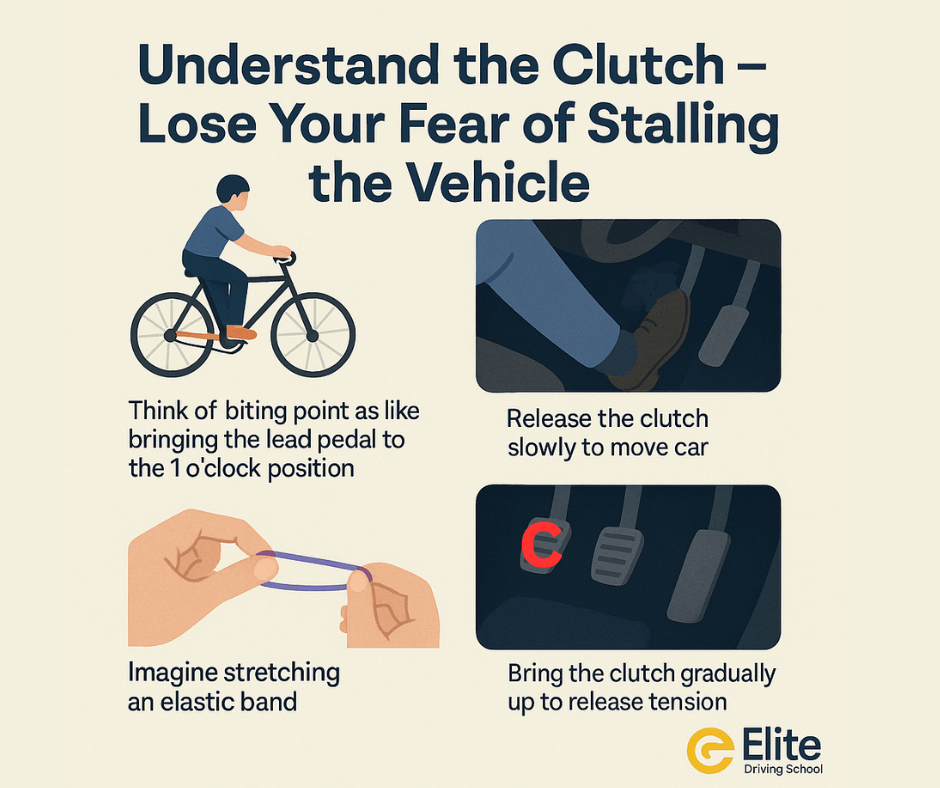
🧠 Think About an Elastic Band
Here’s another way to imagine how the clutch works.
Picture an elastic band looped over your thumb and stretched over the fingers of your other hand.
You can feel the tension pulling between your fingers.
If you let go suddenly, it snaps back. But if you bring your hands together slowly, the tension eases until the band returns to its natural shape.
That’s what happens inside your car’s clutch.
When you press the pedal all the way down, it’s like stretching that elastic band to its limit — maximum tension.
As you lift the pedal, you release that tension gradually, connecting the engine and the wheels smoothly.
The moment you start to feel the car move — your lifting the clutch beyond biting point.
⚙️ The Key to Smooth Driving
You can lift the clutch briskly until you reach the biting point, but from that point onward, move it slow and steady.
As the car begins to move, it needs time to fully engage, therefore you can increase the gas slightly, don’t get too heavy footed on the gas pedal.
You’ll notice the car travels a short distance before you can completely release the clutch pedal.
Once you understand this, you’ll lose your fear of stalling.
You’ll feel calmer, more confident, and your car will respond better — making every move smoother.
💡 Takeaway
Think of the clutch as your bike pedal and an elastic band working together — power and control through smooth movement.
When you understand it, driving becomes easier, smoother, and far more enjoyable.
✅ Ready to Practice What You’ve Learned?
If you’re ready to build your confidence and master clutch control, our friendly instructors can help.
At Elite Driving School, we’ll teach you step by step how to drive smoothly — no stress, no panic, just progress.
👉 Book your first driving lesson today and start your journey with confidence!