
Tip For Smart Drivers
Too many drivers do the same thing without really thinking.
The car in front moves off, so they move off.
The traffic bunches up, so they bunch up.
The driver behind gets impatient, so they feel pressured to speed up.
That is lemming driving.
Good drivers do the opposite. They think for themselves. They read the road. They make calm decisions. One of the clearest signs of a smart driver is this: they leave space.
A safe following distance is one of the simplest ways to stay in control, avoid harsh braking, reduce stress, and protect yourself from other people’s mistakes. It gives you time to react, time to slow down, and time to make better choices.
That matters because the roads are full of drivers who rush, crowd, and copy bad habits without thinking. If you want to become a better driver, you have to stop following the crowd and start using your own judgment.
Why space matters more than most drivers realise
Many drivers treat a gap in traffic like a problem. They see space ahead and want to fill it straight away. They get too close to the vehicle in front, brake late, and leave themselves with no breathing room at all.
That is poor driving.
Space is not wasted road. Space is your safety zone. It gives you time to see problems developing and deal with them calmly. Without that space, even a small change ahead can turn into a rushed reaction.
A driver who leaves a proper gap is usually smoother, calmer, and more in control. They are less likely to brake sharply. They are less likely to panic. They are less likely to be dragged into someone else’s bad driving.
That is why safe following distance is not just a test-day idea. It is a real-world driving habit that protects you every time you get behind the wheel.
Think in time, not just distance
A lot of people talk about following distance as if it is a fixed number of metres or car lengths. In reality, the smarter way to think is in time.
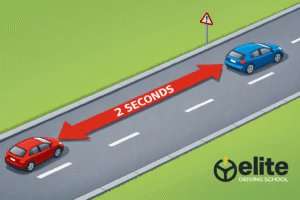
When traffic is moving at normal speed, you should aim for at least a two-second gap in dry conditions. If the weather is poor, that gap needs to increase. In wet conditions, you should at least double it. In icy conditions, it needs to be much more.
This is where good drivers separate themselves from careless ones.
They do not just copy what the car in front is doing. They think about road conditions, visibility, speed, and grip. They adjust the gap to match the situation.
That is proper driving.
Why bunching up is a bad habit
You see it every day. Cars travel in a line, each one sitting too close to the next. Nobody seems to want to be the one who leaves a sensible gap.
It is daft.
When drivers bunch up, they reduce their thinking time. They force themselves into late braking. They create tension. They increase the chance of a shunt if traffic suddenly slows down. They also make life harder for everyone around them because one bad reaction can spread backwards through the whole line of traffic.
A proper gap smooths everything out.
It gives you a chance to ease off early instead of stamping on the brake. It helps you keep the drive calm and controlled. It reduces the stop-start effect that so many poor drivers create by being too close to the vehicle ahead.
In simple terms, leaving space often makes you the better driver in a line of bad ones.
What to do when traffic is slow
Some people get confused about following distance in queues and slow-moving traffic. They assume they must always leave a huge space in front, even when traffic is crawling.
That is not the point.
In slow-moving traffic, the gap can naturally be smaller than it would be at higher speeds. But smaller does not mean silly. You still need enough room to stop safely and enough room to react if something unexpected happens.
You do not want to be glued to the bumper in front. You still need a little bit of breathing space.
This is where calm judgment matters. You keep the traffic flowing, but you do not crowd the vehicle ahead just because everybody else is doing it.
Again, this is where thinking for yourself beats following the herd.
When stationary, leave yourself an escape space
When you stop behind another vehicle, do not roll right up to the back of it.
A very good rule of thumb is to stop far enough back that you can still see the rear wheels of the vehicle in front touching the tarmac. That gives you a useful buffer and helps avoid stopping too close.
Why does that matter?
Because if the vehicle ahead breaks down, rolls back, or gets stuck, you are not trapped. You have room to move. You also give yourself a bit more safety if the vehicle behind you stops badly.
Too many drivers stop nose to tail and leave themselves with nowhere to go. It is lazy driving.
Stopping with a sensible gap is one of those small habits that shows a driver is switched on.
As traffic moves, rebuild the gap
This is where a lot of drivers go wrong.
Traffic starts moving, and instead of letting the gap open naturally, they chase the car in front straight away. They close up too soon and go back to bumper-following within seconds.
A better approach is to let the space build gradually.
As the vehicles start to move, do not rush to fill every inch of road. Let the gap grow. Then, as speed increases, let it grow again until you are back to a proper time gap.
That gives you a much smoother drive.
It also helps with clutch control, gear changes, braking, and general planning. Instead of reacting to the vehicle ahead, you are reading the road and creating your own safety cushion.
That is exactly how a thoughtful driver should drive.
What if someone is tailgating you?
This is the moment when many drivers lose their nerve.
Someone comes up too close behind, and suddenly they feel pressured. They speed up when they should not. They brake late. They stop focusing on what is happening ahead because they are too busy worrying about the car behind.
Do not let that happen.
If someone is tailgating you, the worst thing you can do is join in with the panic. Do not speed up just because they are impatient. Do not brake sharply to make a point. Do not let their bad driving control your decisions.
Stay calm. Keep looking well ahead. Keep driving smoothly.
Most importantly, increase the space in front of your own car. That gives you more room to brake gently if needed and reduces the chance of being forced into a sudden stop.
That is a smart response. It lowers the risk and keeps you in control.
So if someone is too close behind you, do not become the second problem. Stay cool, leave more space, and drive your own car properly.
Bigger vehicles need bigger thinking
Following distance becomes even more important when you are behind a van, bus, or lorry.
Why? Because large vehicles block your view.
If you sit too close behind them, you lose the ability to see what is happening further up the road. You cannot read bends properly. You cannot spot brake lights ahead as early. You cannot see hazards developing until it is too late.
That means you are no longer planning. You are just reacting.
Good drivers understand this and drop back. They leave more room, improve their view, and give themselves more time to think.
That is not weakness. That is intelligence.
If your view is blocked, your distance should increase. Simple as that.
Why this matters on driving lessons
This is one of the best habits a learner can build early.
A learner who understands safe following distance usually becomes a smoother, calmer driver. They stop rushing. They stop chasing traffic. They start planning ahead.
That has a knock-on effect on everything else.
Their braking becomes better.
Their gear changes become smoother.
Their observation improves.
Their confidence grows.
Why? Because space gives them time.
Time is everything when you are learning to drive. If you are always too close to the vehicle ahead, every decision becomes rushed. If you leave space, the whole drive becomes easier to manage.
That is why good driving lessons should not just teach pupils how to move a car. They should teach them how to think, plan, and stay in control.
Why this matters after the test
Some drivers treat safe following distance like something they only need to remember for the practical test.
That is the wrong attitude.
This habit matters far more after you pass.
Once the L-plates are gone, you will be driving in busier traffic, worse weather, darker roads, and more mixed conditions. You will meet impatient drivers, sudden stops, poor lane discipline, and all sorts of nonsense.
The one thing that keeps helping in all of those situations is space.
Space gives you time to react.
Space gives you options.
Space makes you calmer.
Space keeps you safer.
This is one of those driving habits that keeps paying you back for life.
The real message: don’t follow the crowd
“Don’t be a lemming” is not just a catchy phrase. It is a proper driving lesson.
Do not follow other drivers blindly.
Do not assume the crowd is doing it right.
Do not let impatient people set the pace for your decisions.
Think for yourself.
Leave a good separation distance from the vehicle ahead. If someone is tailgating you, increase that gap even more so you are less likely to need harsh braking. When stationary, leave enough room so you are not trapped too close to the traffic in front. As the traffic starts to move, let the space build naturally until you are back to a proper gap.
It is simple advice, but it is powerful.
The best drivers are not the ones who sit closest to the bumper in front. They are the ones who stay calm, read the road properly, and leave themselves room to think.
That is the kind of driving that helps you pass.
More importantly, it is the kind of driving that helps you stay safe long after the test is over.
At Elite Driving School, we believe driving lessons should teach more than just the basics. They should help learners develop the habits that make them safer, calmer, and more capable on real roads in real traffic.
Because good driving is not about following the crowd.
It is about thinking for yourself.
Want to learn to drive with calm, clear coaching that helps you think for yourself on the road? Explore driving lessons with Elite Driving School and build skills that last far beyond test day Click here